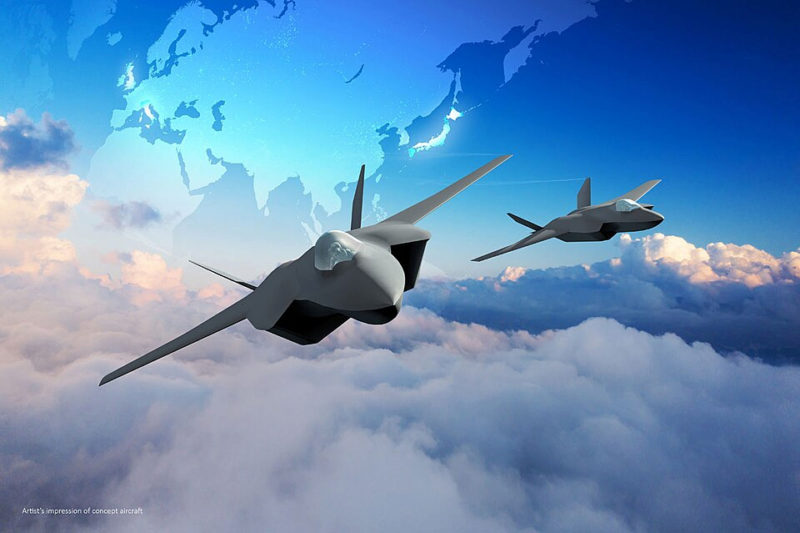
The Global Combat Air Programme (GCAP)—a sixth-generation fighter jet project jointly developed by the UK, Italy, and Japan—was originally scheduled to enter service in 2035. However, Lorenzo Mariani, Co-General Manager of Italy’s Leonardo, indicated that, driven by the defense ministers of the participating nations, the initial deployment of GCAP could be brought forward by a full two years to 2033.
Mariani stated that the military urgently requires this multi-domain combat system to become operational as soon as possible. To save time, the program will adopt an “incremental delivery” strategy for the initial version: specifications for the first batch of aircraft will be slightly adjusted and scaled back, with full operational capability achieved through subsequent upgrades.
This implies that Edgewing—the joint venture leading the development, comprising the UK’s BAE Systems, Italy’s Leonardo, and the Japan Aerospace Industry Association (JAIE)—must significantly compress the timelines for testing and low-rate initial production.
This accelerated schedule is critical for Japan, as its current F-2 fighter fleet is slated for retirement around 2035, necessitating a timely—or even early—handover to the new aircraft. As the program advances, Canada has joined as an observer, while Singapore and Saudi Arabia have also expressed interest in participating.
However, the window for the alliance to recruit new partners is closing. Mariani noted that, based on research, development, and production schedules, there is at most one year left—until 2027—to accept new nations. Beyond that deadline, admitting new core partners would risk disrupting the development progress.
The deadline proposed by Mariani not only highlights the challenges inherent in advancing the program but also sends a clear message to potential partners—such as Germany and Spain (following the collapse of the FCAS project) or Sweden (which previously participated but withdrew)—that “now is the time to join.”